How to Write a Resume for Finance and Accounting Roles in Canada (2026 Guide)
Written by ResumeNorth
Finance and accounting hiring in Canada rewards precision — both in the numbers you work with and in how you present your resume. This is a field where vague claims get noticed immediately, and specific, quantified evidence stands out fast.
Where Should You Place Your CPA Designation?
It depends on relevance and recency, not a fixed rule. List certifications above your education when they're recent, highly relevant to the role, or explicitly required by the job posting — this puts your strongest credential where a recruiter sees it first. List them below education when they're older or less central to the specific role you're applying for.
For most working CPAs applying to accounting or finance roles, the designation is usually strong enough to lead with — placed prominently near the top of the resume, not buried in a certifications list at the bottom.
What Skills Should You List, and How Specific Should They Be?
Be specific about software — this is one of the most common, easily-fixed mistakes. "Proficient in accounting software" tells a recruiter and an ATS system almost nothing. Name the actual tools: QuickBooks, Sage, SAP, Power BI, and specify Excel skill level if it's genuinely advanced (pivot tables, macros, financial modeling).
A well-structured skills section separates hard and soft skills clearly:
Hard skills: GAAP financial reporting, tax preparation and filing, financial analysis, budgeting and forecasting, audit procedures, reconciliations, QuickBooks/SAP/Power BI proficiency
Soft skills: cross-departmental communication, attention to detail, ethical integrity, adaptability
One 2026-specific addition worth including if genuinely true: data fluency tools like SQL or Python are increasingly expected alongside traditional accounting skills, particularly for financial analyst and corporate finance roles — this isn't just a "nice to have" anymore in many postings.
How Should You Write Accounting Experience Bullets?
Quantify everything you can — this field has more naturally available numbers than almost any other, so there's rarely a good excuse for a vague, duty-focused bullet.
Weak:
"Responsible for month-end close and financial reporting."
Strong:
"Led a team that implemented a new accounting system, reducing month-end close time by 20%."
Also strong:
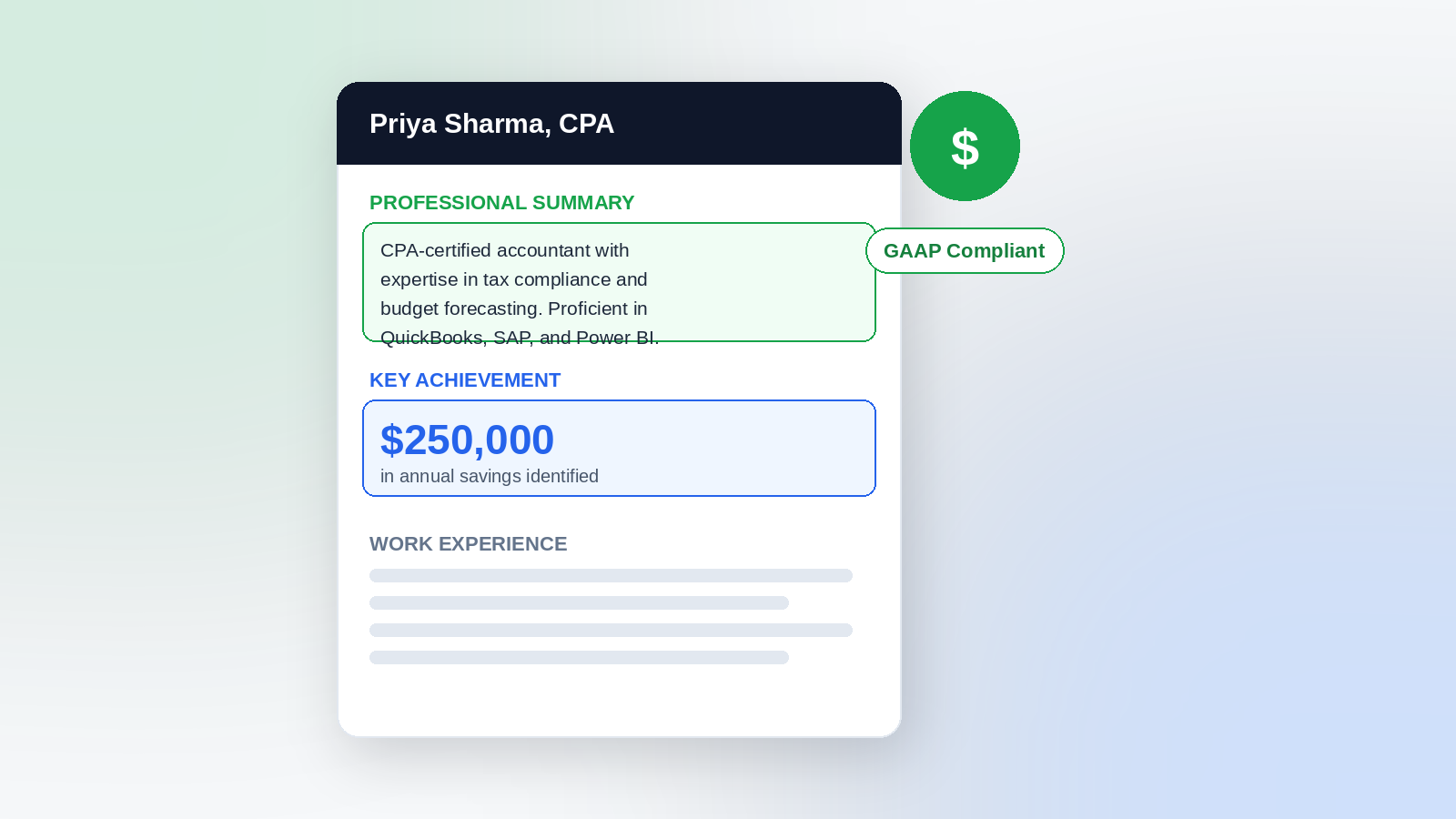
"Identified and implemented cost-saving initiatives leading to $250,000 in annual savings."
Every one of these is a genuine, specific, measurable claim — exactly what both ATS keyword matching and a human hiring manager respond to.
Should You Use a Summary Statement or an Objective?
Use a professional summary, not an old-style objective statement. This distinction matters more in finance/accounting than some other fields, since the field tends to attract more traditional, formal resume conventions — and a summary genuinely communicates more useful information.
Weak (objective, outdated):
"To obtain a position in your company and grow my career."
Strong (summary, specific):
"CPA-certified accountant with expertise in tax compliance and budget forecasting, seeking to optimize financial operations at [Company]."
For entry-level candidates without a CPA yet:
"Detail-oriented accounting graduate with practical training in accounts payable, accounts receivable, bank reconciliation, and financial record maintenance. Proficient in QuickBooks Online and Excel, seeking an entry-level accounting role to build Canadian experience."
What Should Internationally Trained Accountants Include?
International accounting credentials — ACCA (UK), CPA-CA (India), and similar designations — are genuinely respected in Canada, especially by employers familiar with global finance talent. But CPA Canada equivalency is the key unlock for upward mobility into more senior roles, so your resume should clearly state:
- Your international credential and country of certification
- Whether you've pursued CPA Canada's International Credential Recognition process, or where you currently stand in that process
- Canadian accounting terminology and standards knowledge (GAAP specifically, since accounting standards can differ meaningfully between countries)
Stating this clearly and honestly — rather than presenting a foreign designation as though it's directly equivalent — builds credibility rather than raising questions a recruiter has to chase down.
Key Takeaways
- Place your CPA designation based on relevance and recency, not a fixed rule — lead with it if it's your strongest asset
- Name specific software (QuickBooks, SAP, Power BI) — never a vague "accounting software" catch-all
- Quantify every accomplishment possible — this field has more available numbers than most
- Use a professional summary, not an outdated objective statement
- Data fluency (Excel, increasingly SQL) is now an expected skill alongside core accounting competence
- Internationally trained accountants should clearly state their credential and CPA Canada equivalency status
Frequently Asked Questions
Do I need the CPA designation to get an entry-level accounting job in Canada?
Not necessarily — many entry-level bookkeeping and accounting clerk roles don't require it, though pursuing it (and stating that you're in progress) can strengthen an application even before you're fully certified.
Should I list every accounting software I've ever used?
List what's genuinely relevant to the role and what you're proficient in, not a padded list — 3-5 specific, relevant tools are more convincing than ten vaguely-remembered ones.
How important is Excel proficiency specifically?
Very — it remains one of the most consistently required skills across accounting and finance roles, and if you have advanced skills (pivot tables, macros, financial modeling), state that specifically rather than a generic "proficient in Excel."
Is a cover letter expected for finance/accounting roles?
Often yes, particularly for CPA-track or more senior roles — this field tends to retain more traditional application expectations than some others.
Related articles
How to Write a Resume for Retail and Customer Service Roles in Canada (2026 Guide)
How to write a retail or customer service resume that gets noticed — the right skills, how to prove them, and what's changed for 2026.
Read articleHow to Write a Resume for a Tech/Software Job in Canada (2026 Guide)
How to write a software engineer or tech resume that passes ATS and impresses technical recruiters — skills formatting, GitHub, AI tools, and bullet structure.
Read articleHow Long Should a Resume Be in 2026? (One Page vs. Two)
How long should a resume be in Canada? One page under 5 years, two pages after — plus word counts, font and margin limits, and the federal-government exception.
Read article
Sources
- Randstad Canada — Your Ultimate Guide to Trending Accounting Skills in 2026
- Jobscan — Best Accountant Resume Examples for 2026
- Enhancv — 20 CPA Resume Examples - 2026
- The Mason Group — The Most In-Demand Accounting & Finance Certifications in 2026
- Robert Half — Writing a Canadian CPA Resume: Examples and Tips
- Get Trained Get Hired — Accounting Resume in Canada: 2026 Writing Guide