How to Write a Resume for Healthcare and Nursing Roles in Canada (2026 Guide)
Written by ResumeNorth
Healthcare hiring in Canada runs through a layer most other industries don't have: regulatory compliance. A hiring manager — and often the ATS before them — isn't just checking whether you're qualified, they're checking whether you're legally permitted to practice in that province, right now. Getting this piece wrong is one of the most common, and most avoidable, reasons a strong nursing or healthcare resume gets passed over.
Where Should Licensing and Certifications Go on Your Resume?
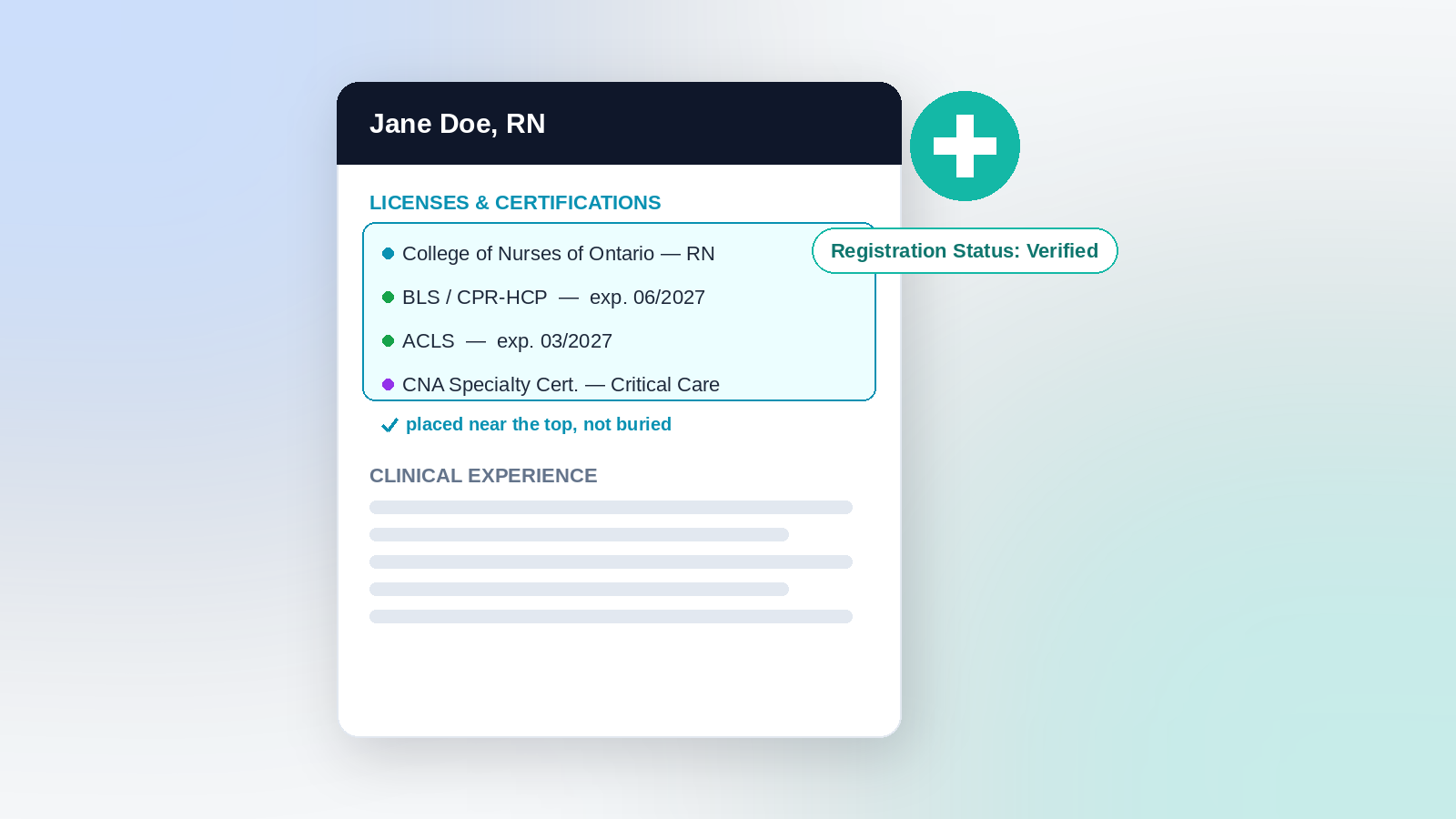
Near the top — not under Education, and never buried three sections down. This is one of the most common and costly mistakes in healthcare resumes. A real example that illustrates the cost: a new graduate nurse with a completed College of Nurses of Ontario (CNO) registration and provisional registration number listed her credential — but under "Education," mixed in with unrelated coursework. Recruiters scanning quickly moved on to resumes where the registration was immediately obvious. Her application never advanced past the initial compliance review.
The fix: create a dedicated, clearly labeled "Licenses & Certifications" section positioned near the top of your resume, right after your summary — not folded into your education history.
What Should Each Certification Entry Include?
Every certification needs three things: the certification name, the issuing body, and the expiry date. For nursing specifically, an expired certification isn't just a minor gap — it can be outright disqualifying for acute care roles, since these credentials aren't optional extras, they're legal requirements to practice.
Commonly required or near-mandatory for acute care roles:
- Basic Cardiac Life Support (BCLS) / BLS — include expiry date
- CPR Level HCP (Healthcare Provider) — most provincial regulatory bodies require current CPR for registration
- ACLS, PALS, or other specialty-specific certifications relevant to your unit
One of the strongest single credentials you can add: a specialty certification through your national nursing association (20+ specialties are available through examination) — Canadian hospitals actively prefer certified nurses for specialty units, and this can meaningfully differentiate an otherwise similar resume.
How Should You Handle Provincial Licensing Differences?
Nursing regulation in Canada is provincial, not national, and requirements differ meaningfully between provinces:
- Ontario: regulated by the College of Nurses of Ontario (CNO)
- British Columbia: regulated by CRNBC
- Quebec: regulated by the Ordre des infirmières et infirmiers du Québec (OIIQ), which requires passing the OIIQ licensing exam and French language proficiency
The practical takeaway: state your specific provincial registration clearly and accurately — "Registered Nurse — College of Nurses of Ontario" is far stronger and more precise than a generic "Licensed RN" that leaves a recruiter guessing which jurisdiction you're actually credentialed in.
What Should Internationally Educated Nurses (IENs) Include?
Internationally trained nurses are urgently needed across Canada, but face a genuinely complex registration process — and how you present your status on a resume matters significantly.
What to include, clearly and near the top:
- Your current registration status — e.g., "CNO Registration — Application in Progress, Expected [Month Year]," including your application reference number if you're mid-process
- Your country and nursing school
- Whether you've completed a credential assessment — World Education Services (WES) for academic credentials, or a nursing-specific assessment from the relevant regulatory body
- Clinical experience described using Canadian terminology — "Medical-surgical unit" rather than the equivalent term from your home country's system, since Canadian employers and ATS systems are matching against Canadian-standard terms
Example — adapting an international role for a Canadian resume:
Staff Nurse – ICU | King Faisal Hospital, Riyadh, Saudi Arabia | 2013–2018 [Bullets describing responsibilities using Canadian clinical terminology and unit naming conventions]
Learn more about our plan via: resumenorth.com/pricing.
Should You Name Specific Software and EHR Systems?
Yes, always — and this is an easy, high-value fix most candidates skip. Electronic health record systems are not interchangeable, and hiring managers know it. If you've trained on and used a specific system, name it explicitly: Cerner, Epic, OSCAR EMR — not the vague catch-all "electronic health records," which tells a recruiter and an ATS system almost nothing about your actual technical readiness for their specific environment.
How Do You Write Strong Clinical Experience Bullets?
Use the same principle that applies across every industry — results and outcomes, not just duty description — but grounded in genuine clinical metrics where you have them.
Weak (duty-focused):
"Responsible for patient care on a busy telemetry unit."
Strong (outcome-focused, specific, quantified):
"Supervised 12 RNs and 4 CNAs on a 30-bed telemetry unit, improving HCAHPS communication scores from 78% to 92% in one year."
Not every role will have a metric this clean available, but wherever you do have real numbers — patient load, unit size, measurable outcome improvements — use them.
Key Takeaways
- Place licensing and certifications near the top of your resume, in a clearly labeled dedicated section — never buried under Education
- Every certification needs the issuing body and expiry date; expired credentials can be disqualifying
- State your specific provincial regulatory body accurately (CNO, CRNBC, OIIQ, etc.)
- Internationally educated nurses should clearly state registration status, application progress, and credential assessment near the top
- Name specific EHR systems and clinical software — generic terms tell recruiters and ATS systems nothing
*Use reverse-chronological order, and quantify clinical outcomes wherever genuine data supports it
Frequently Asked Questions
Should I list a certification that's about to expire?
Yes, but renew it as soon as possible before applying — an active certification with a near-term expiry date is honest and acceptable; an already-expired one can disqualify your application outright for acute care roles.
How should I handle a nursing role from a country with a very different healthcare system?
Translate your responsibilities into Canadian clinical terminology and unit naming conventions wherever there's a reasonable equivalent, while keeping the original institution name and dates accurate and unchanged.
Do I need a different resume for each province I'm applying to?
Not a full rewrite, but you should adjust the specific regulatory body referenced (CNO vs. CRNBC vs. OIIQ, etc.) to match the province of each application — this detail matters and shouldn't be generic.
Is a cover letter necessary for healthcare roles?
It's often expected, particularly for internationally educated nurses navigating the registration process, since a cover letter can provide brief context a resume's structured format doesn't easily accommodate.
Related articles
How to Write a Resume for Retail and Customer Service Roles in Canada (2026 Guide)
How to write a retail or customer service resume that gets noticed — the right skills, how to prove them, and what's changed for 2026.
Read articleHow to Write a Resume for a Tech/Software Job in Canada (2026 Guide)
How to write a software engineer or tech resume that passes ATS and impresses technical recruiters — skills formatting, GitHub, AI tools, and bullet structure.
Read articleHow Long Should a Resume Be in 2026? (One Page vs. Two)
The real data on resume length in 2026 — when one page is still right, when two pages is now preferred, and why padding your resume always backfires.
Read article
Sources
- [Resumefy — RN Resume Canada (2026) — Free Template, CNO & NCLEX Guide] (
- [WAH Resume — Top Resume Keywords for Canadian Healthcare Jobs 2026] (
- [Resumemate — Nurse Resume Examples (Clinical Skills & Certifications)] (
- Caring Support — What Should a Strong Nurse Resume Include for Canadian Healthcare Employers in 2026?