Resume Bullet Points: How to Write Ones That Get Noticed (2026 Guide)
Written by ResumeNorth
Bullet points are the most-read, most-scanned part of your entire resume — and also the most commonly written as a passive duty list instead of a genuine achievement record. Fixing this is one of the highest-leverage edits you can make.
What Makes a Resume Bullet Actually Strong?
A strong bullet does three things at once:
- Starts with a specific action verb — not "Responsible for" or "Helped with"
- Provides real context — what you did it on, for whom, at what scale
- Ends with a quantified result — a number that shows what changed because of you
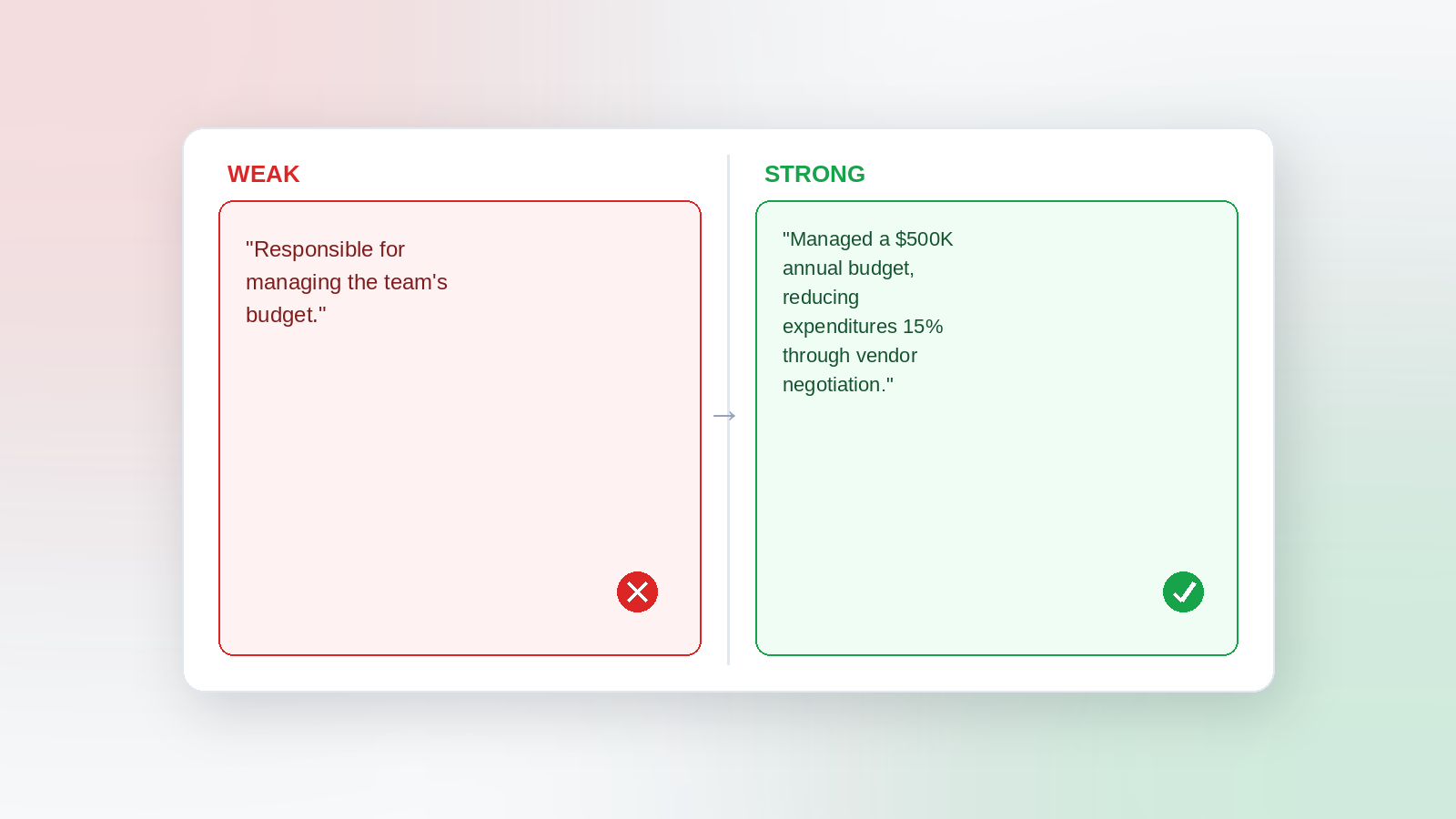
Weak:
"Responsible for managing the team's budget."
Strong:
"Managed a $500K annual budget, reducing expenditures 15% through vendor negotiation."
The weak version describes a duty — something you were assigned. The strong version describes an outcome — something you delivered. ATS systems and human recruiters both weight the second pattern more heavily, since it correlates directly with genuine, measurable impact.
Why Does "Responsible For" Specifically Hurt You?
Because it signals passive involvement rather than ownership, and recruiters have learned to read it that way. Recruiters typically skim only the first 2-3 words of each bullet during an initial scan — if those words are "Responsible for," the bullet reads as a task list item before the reader even gets to the rest of the sentence.
Studies on action-verb usage suggest resumes built around strong, specific verbs can be up to 140% more likely to lead to an interview compared to those built around passive duty language. That's a large enough gap to justify rewriting every "responsible for" on your resume, without exception.
How Many Bullets Should Each Job Have?
3-6 bullets per role, scaled by relevance and recency:
- Most recent or most relevant roles: 4-6 bullets
- Older or less relevant roles: 2-3 bullets
Keep each bullet to 1-2 lines — a three-line bullet is almost always too long and should be cut down or split. Given recruiters spend only 6-8 seconds on their first scan, a wall of dense, long bullets works against you even if the content is strong; length itself becomes a barrier to being read at all.
What Frameworks Help Structure a Strong Bullet?
A few common frameworks all point toward the same underlying structure:
- Action + Metric + Impact — the verb, a number, and why it mattered
- CAR (Challenge, Action, Result) — what problem existed, what you did, what changed
- BAR (Background, Action, Result) — similar structure, slightly more context-forward
Whichever framework you use, the test is the same: does this bullet contain a specific, job-relevant keyword in context, and does it answer "what changed because you were here?" with a number.
A few real examples across different fields:
"Secured 14 mid-market renewals and expanded ARR by $420K through multi-stakeholder account plans."
"Coordinated medication reconciliation on a 32-bed ward, reducing discharge documentation errors 21%."
"Redesigned weekly reporting workflow, saving 11 hours per week and improving forecast accuracy 15%."
Each of these names a specific context (mid-market renewals, a 32-bed ward, a reporting workflow), a real number, and a clear outcome — the same underlying pattern regardless of industry.
What If You Genuinely Can't Find a Number for Something?
Almost everything can be measured with a bit of thought — scale, frequency, team size, or scope can all serve as a number even without a dollar figure or percentage. "Managed onboarding for a team of 8" or "supported a caseload of 40+ clients" are both legitimate quantified bullets, even without a growth percentage attached.
If a role genuinely has no measurable output (some early-career or highly process-based roles), focus on scope and scale instead — team size, volume handled, frequency of a task — rather than forcing a fabricated metric that doesn't hold up under a follow-up question.
Should You Repeat the Same Action Verb Across Bullets?
No — vary your verbs deliberately. A one-page resume with roughly 12 bullets should ideally use 10-12 distinct verbs, not the same 3 repeated throughout. Repetition signals a narrower range of accomplishment types, even when the underlying work was genuinely varied — it's a presentation problem, not usually a reflection of your actual experience.
One exception: if the job posting itself uses a specific verb repeatedly (e.g., "architected," "deployed," "migrated" for a technical role), mirroring that exact language where truthful helps both ATS keyword matching and clarity — this is one case where intentional repetition of the posting's own term is worth it.
Key Takeaways
- Every bullet should start with a specific action verb, include real context, and end with a quantified result
- Never open a bullet with "Responsible for" — it signals a task list, not an achievement
- Use 3-6 bullets per role: more for recent/relevant positions, fewer for older ones
- Keep each bullet to 1-2 lines — recruiters scan in 6-8 seconds
- Vary your action verbs across the resume; don't repeat the same 2-3 throughout
- When a role has no obvious dollar-figure metric, use scale or scope instead — team size, volume, frequency
Frequently Asked Questions
Is it okay to start a bullet with "Led" if I wasn't formally a manager?
Yes, if you genuinely led an initiative, project, or effort — "led" describes ownership of an outcome, not necessarily a job title. Just make sure the claim is accurate to what you actually did.
Should older jobs have the same bullet quality as recent ones?
The same quality standard applies, but with fewer bullets — 2-3 well-written, quantified bullets for an older role are more effective than 5 vague ones.
What if my job description doesn't use strong action verbs at all?
Translate the underlying work into your own strong, accurate verb choice — you're not limited to the language a job title or internal description used; choose the verb that best captures what you actually did.
Can a bullet be too quantified — like stuffed with too many numbers?
Yes — one clear, meaningful metric per bullet is usually enough. Cramming in multiple numbers can make a bullet harder to read quickly, which works against the 6-8 second scan reality.
Related articles
How to Write a Resume for Retail and Customer Service Roles in Canada (2026 Guide)
How to write a retail or customer service resume that gets noticed — the right skills, how to prove them, and what's changed for 2026.
Read articleHow to Write a Resume for a Tech/Software Job in Canada (2026 Guide)
How to write a software engineer or tech resume that passes ATS and impresses technical recruiters — skills formatting, GitHub, AI tools, and bullet structure.
Read articleHow Long Should a Resume Be in 2026? (One Page vs. Two)
How long should a resume be in Canada? One page under 5 years, two pages after — plus word counts, font and margin limits, and the federal-government exception.
Read article
Sources
- Resumeway — 240+ Resume Action Verbs with Examples (2026)
- ResumeAdapter — 100+ Powerful Action Verbs for Your Resume: Beat the ATS in 2026
- TalentTapped — How to Write Resume Bullet Points That Pass ATS and Get Read
- TailorCV — How to Write Resume Bullet Points That Get Noticed (With Examples)
- NeuraCV — Resume Action Verbs for ATS 2026 (120+ Examples)