How to Write a Resume Summary Statement That Actually Gets Read (2026 Guide)
Written by ResumeNorth
Most job seekers either skip the summary section entirely, write something generic enough to belong to anyone, or — worst of all — still use an objective statement pattern from over a decade ago. Given how little time a recruiter actually spends on that first scan, this is one of the most fixable, highest-impact mistakes on a resume.
What's the Difference Between a Summary and an Objective?
An objective statement describes what you want — "Seeking a challenging marketing position where I can grow my skills." A professional summary describes what you offer — your experience, your skills, and your best achievement, condensed into a few lines.
This distinction matters more than it might seem. A 2026 survey found 89% of recruiters now prefer professional summaries over objective statements, largely because an objective tells the reader nothing about whether you're actually qualified — it's about your goals, not your value. If your resume still opens with "seeking a position where I can use my skills and grow professionally," that's worth replacing today.
How Long Should a Resume Summary Be?
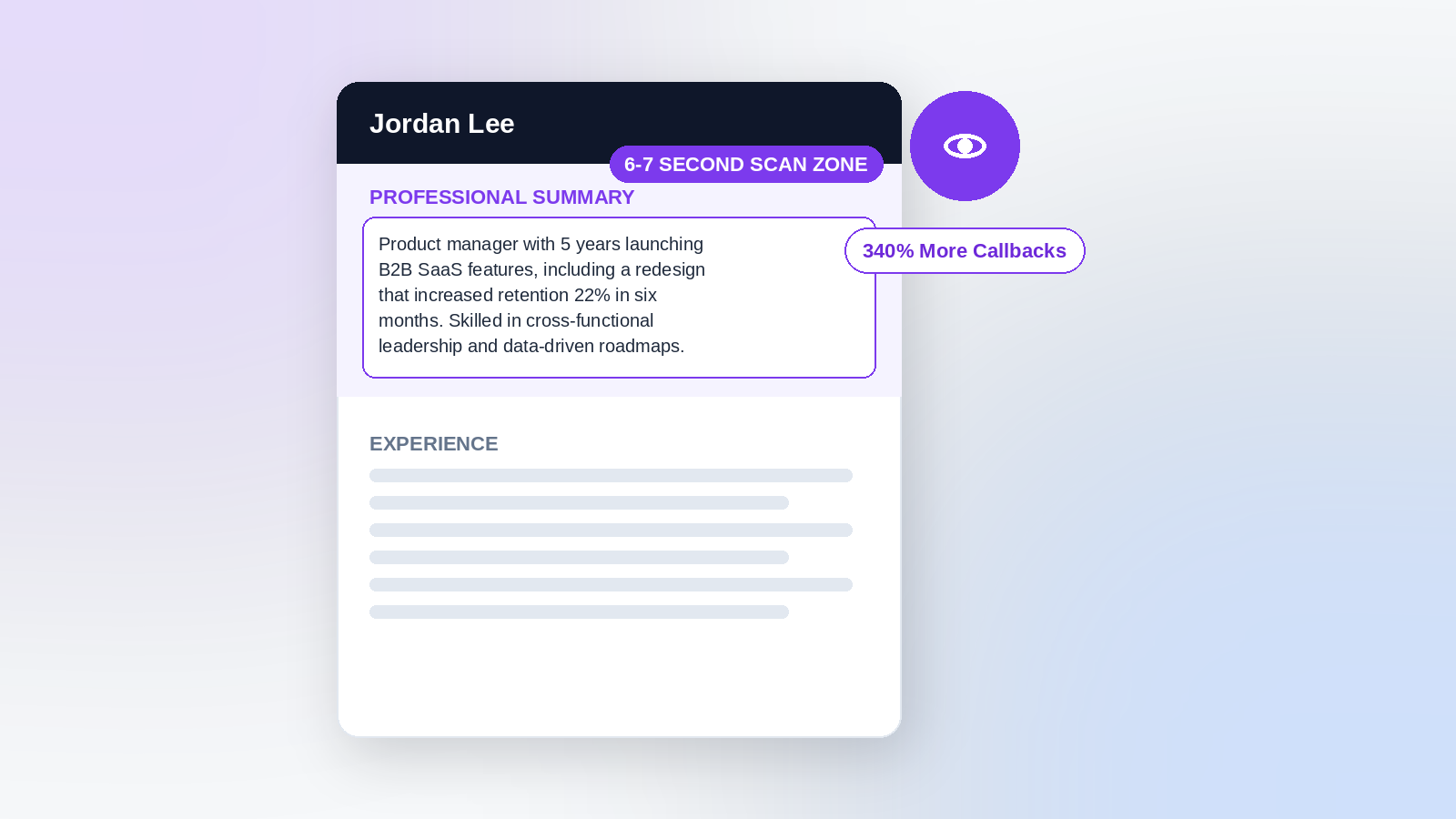
2-5 sentences, roughly 100-150 words. This isn't an arbitrary rule — it matches how little time a recruiter actually spends on the initial scan. Given recruiters spend only about 6-7 seconds on that first pass, a summary running 6+ lines will simply get skipped, defeating its entire purpose.
A useful mental model: your summary is an executive pitch, not a biography. It should condense the most important things about you into the space a recruiter will genuinely read during that brief scan — not attempt to cover everything.
Why Does the Summary Matter So Much If It's So Short?
Because of where it sits and how recruiters actually read. Eye-tracking research confirms recruiters read the top third of a resume first — if the summary doesn't hook them there, the rest of the page often goes unread entirely. This is a structural reality of how resumes get screened, not a stylistic preference.
The data backs up the impact: resumes that include a strong professional summary have been found to receive substantially more interview callbacks than those that open with an objective or skip the section altogether, and separately, about 30% more people read a full resume through to the end when it opens with a summary versus when it doesn't.
What Should a Strong Summary Actually Include?
Three layers, in this order:
- Identity — your job title or professional identity, stated clearly
- Achievement — your single strongest, most specific accomplishment
- Value proposition — what you bring to the specific role you're applying for
Weak (vague, could belong to anyone):
"Experienced product manager with strong leadership skills and a passion for building great products."
Strong (specific, with a real number):
"Product manager with 5 years of experience launching B2B SaaS features, including a redesign that increased user retention 22% in six months. Skilled in cross-functional leadership and data-driven roadmap prioritization."
The second version tells a reader exactly who you are, what you've delivered, and whether you're worth reading further — all in the space of a few seconds.
Should Your Summary Match Your Experience Bullets?
Yes — and this is a detail most resumes get wrong. The summary and your experience section shouldn't be written as separate exercises. When a recruiter finishes the 6-second summary scan, their eyes typically drop straight to the first bullet of your most recent role. If the language, verbs, and metrics in those two places don't reinforce each other, the resume reads as inconsistent, and the reader's confidence in the summary's claims drops.
The fix: echo the same verbs, the same metrics, and the same domain language between your summary and the bullets directly below it. The summary makes a claim; your experience section should immediately confirm it.
Should You Tailor Your Summary for Every Application?
Yes, at least at the keyword and emphasis level. Incorporate language directly from the job description — job titles, required skills, and industry-specific terminology — since this helps both ATS matching and a human reader immediately see the fit. You don't need to rewrite the whole summary from scratch each time, but the emphasis and specific terms should shift to match what each posting is actually asking for.
How often to update the substance (not just keywords): revisit your summary every time you have a new achievement, skill, or certification worth adding — a reasonable check-in cadence is at least every six months, or after any significant career milestone.
Key Takeaways
- Keep it to 2-5 sentences, roughly 100-150 words — recruiters only spend 6-7 seconds on the initial scan
- Use a professional summary, not an outdated objective statement — 89% of recruiters now prefer it
- Structure it as identity → achievement → value proposition, always with a specific, quantified accomplishment
- Make sure your summary and your top experience bullets echo the same language and metrics
- Tailor keywords and emphasis to each job posting, and refresh the substance every 6 months or after a major achievement
Frequently Asked Questions
Is a summary necessary for an entry-level resume with limited experience?
Yes — even with limited professional experience, a short summary highlighting relevant coursework, internships, or a specific project result gives a recruiter useful context before they scan the rest of the page.
Should I write "results-driven professional" or similar phrases?
Avoid generic phrases like this — they're common enough to be functionally meaningless to a recruiter who reads dozens of resumes. Replace them with a specific, real detail: what results, driven by what, proven how.
Can a summary be too specific?
Not usually — specificity is what makes a summary effective. The more common failure mode is being too vague, not too detailed, within the 2-5 sentence limit.
Do I need a different summary for every single job I apply to?
Not a full rewrite each time, but adjust the keywords, emphasis, and which achievement you lead with to match what each specific posting is asking for.
Related articles
How to Write a Resume for Retail and Customer Service Roles in Canada (2026 Guide)
How to write a retail or customer service resume that gets noticed — the right skills, how to prove them, and what's changed for 2026.
Read articleHow to Write a Resume for a Tech/Software Job in Canada (2026 Guide)
How to write a software engineer or tech resume that passes ATS and impresses technical recruiters — skills formatting, GitHub, AI tools, and bullet structure.
Read articleHow Long Should a Resume Be in 2026? (One Page vs. Two)
How long should a resume be in Canada? One page under 5 years, two pages after — plus word counts, font and margin limits, and the federal-government exception.
Read article
Sources
- StylingCV — Professional Summary for Resume 2026: How to Write One That Gets You Hired, citing Ladders Eye-Tracking Study data and a 2026 ResumeGo survey
- Resume Optimizer Pro — Resume Summary Examples for Every Industry and Career Level (2026), citing 2026 resume statistics compiled by StylingCV
- Jobscan — How to Write a Resume Summary (With Examples) for 2026
- happypeopleai — Resume Summary Examples That Recruiters Notice in 2026
- interviewpanel.org — 77+ Resume Summary Examples for 2026 (+How-to Guide), citing The Ladders 2024 scan-time research