How to Write a Resume for Skilled Trades in Canada (2026 Guide)
Written by ResumeNorth
Trades hiring runs on a layer of compliance most office jobs don't have: certifications and safety tickets aren't nice-to-haves, they're often legal requirements before you can even set foot on a job site. A resume that buries this information, or presents it vaguely, creates real friction for an employer trying to determine whether they can actually hire you.
What Is the Red Seal, and Why Does It Matter on Your Resume?
The Red Seal is Canada's national standard of excellence across 56 designated trades — electrician, plumber, carpenter, HVAC/refrigeration technician, welder, automotive service technician, cook, and hairstylist among the most common. Once you pass the interprovincial Red Seal exam (built from your trade's National Occupational Analysis, requiring roughly 70% to pass), you earn a Red Seal endorsement on your provincial certificate — recognized in every province and territory, with no re-testing required if you relocate.
This matters directly to your resume because Red Seal holders are reported to earn 15-25% more than non-certified tradespeople, and employers actively prioritize Red Seal candidates for senior or lead positions. If you have it, it should be one of the first things a reader sees — not mentioned in passing partway down the page.
Where Should Certifications and Safety Tickets Go?
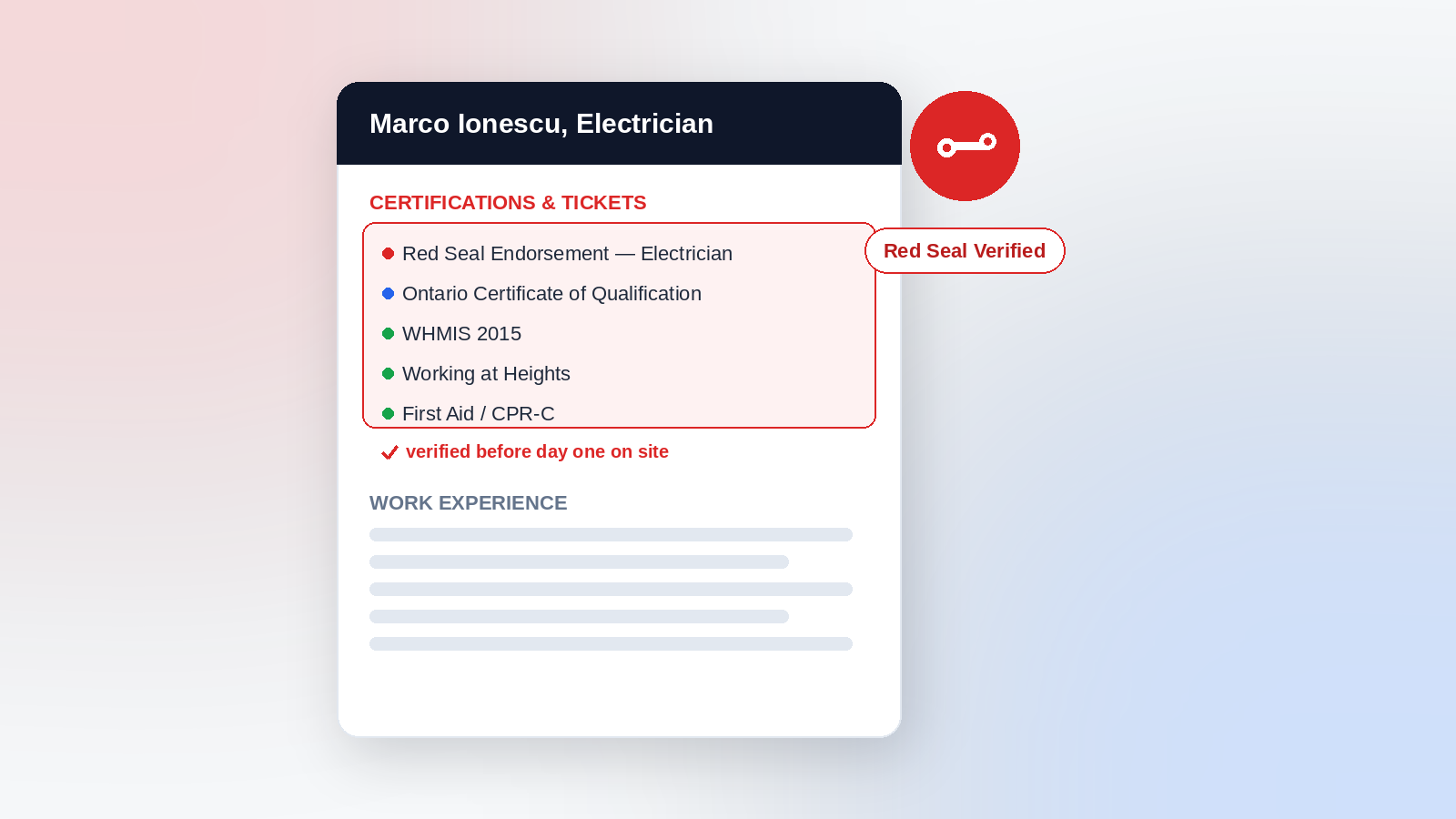
Near the top, in a clearly labelled dedicated section — the same principle that applies to healthcare credentials applies here, for the same underlying reason: employers are checking compliance, not just competence.
What belongs in this section:
- Red Seal endorsement (if held) or your current certification status
- Provincial certification/Certificate of Qualification
- Required safety tickets — these vary by province and trade, but commonly include WHMIS, fall protection, working at heights, confined space entry, and first aid/CPR
- Union membership, if applicable (IBEW for electricians, UA for plumbers and pipefitters, or your local Carpenters' Union chapter)
Many safety tickets are legally required before your first day on a job site — an employer scanning your resume needs to see this instantly, not discover it's missing during onboarding.
What If You're Still Completing Your Apprenticeship?
Be specific and honest about where you are in the process — this isn't a weakness to hide, it's a normal, expected stage that employers hiring apprentices understand well
Include:
- Your current apprenticeship level (e.g., "3rd Year Apprentice Electrician")
- Accumulated hours toward certification — most trades require roughly 5,400 to 9,000 hours of work experience combined with technical training periods
- Expected completion date, if known
This level of specificity signals genuine progress rather than vague, unverifiable experience.
What Should Internationally Trained Tradespeople Include?
If you trained outside Canada, your resume needs to clearly communicate where you stand in the Canadian certification process, since "tradesperson" credentials don't automatically transfer between countries.
Include, stated clearly near the top:
- Your foreign credential assessment status — contact with your provincial trades authority (TSSA in Ontario, ABSA in Alberta, Technical Safety BC, or the equivalent in your province) for an evaluation of your international training
- Whether you're registered as an apprentice or pursuing trade equivalency in Canada
- Your trade experience described using Canadian terminology and equipment naming conventions where they differ from your home country's system
Costs for this process typically run $100-300 for equivalency assessment plus $200-400 for exam fees, and some provinces and immigrant-serving organizations offer grants or low-interest loans to offset this — worth mentioning to a career counsellor if cost is a barrier, though not resume content itself.
How Should You Write Trades Experience Bullets?
Pair hard skills (specific tools, equipment, and techniques you're proficient with) with quantified accomplishments wherever possible, using strong action verbs.
Weak:
"Responsible for electrical installations on residential projects."
Strong:
"Installed and inspected electrical systems on 40+ residential builds, ensuring 100% code compliance across all provincial inspections."
Action verbs like installed, repaired, designed, diagnosed, calibrated carry more weight than passive duty descriptions — and a real number (project count, compliance rate, time saved) makes the claim concrete rather than generic.
What Formatting Works Best for a Trades Resume?
Keep it simple — this is one field where a plain, direct format genuinely outperforms anything stylized. Use a clear, standard font (Arial or Calibri), a single-column layout, and straightforward section headers. Trades hiring managers are typically scanning quickly for compliance and hard-skill match, not evaluating design sensibility — clarity beats visual flair here more than in almost any other field.
Key Takeaways
- Put certifications and safety tickets near the top — employers need to verify compliance immediately, not discover gaps later
- State your Red Seal status clearly, or your apprenticeship level and accumulated hours if still in progress
- Internationally trained tradespeople should clearly state their credential assessment and registration status
- Pair hard skills (tools, equipment, techniques) with quantified results and strong action verbs
- Keep formatting simple and direct — plain and scannable beats stylized in this field
Frequently Asked Questions
Do I need to list every safety ticket I've ever completed?
List the ones relevant to your trade and the specific job you're applying for — a long list of unrelated certifications can dilute the ones that actually matter for this role.
Should I include union membership on my resume?
Yes, if applicable — it can signal training quality and job placement support to an employer, and is worth including in your credentials section alongside your certifications.
How do I handle a trade certification from a country Canada doesn't have a direct equivalency agreement with?
Contact your provincial trades authority for an individual assessment — your resume should state that you're pursuing trade equivalency and note any relevant training or exams completed so far, rather than claiming a Canadian certification you don't yet hold.
Is a cover letter necessary for trades positions?
Not usually required, but can help for apprenticeship applications specifically, where employers may want a brief sense of your motivation and career direction beyond what a resume conveys.
Related articles
How to Write a Resume for Retail and Customer Service Roles in Canada (2026 Guide)
How to write a retail or customer service resume that gets noticed — the right skills, how to prove them, and what's changed for 2026.
Read articleHow to Write a Resume for a Tech/Software Job in Canada (2026 Guide)
How to write a software engineer or tech resume that passes ATS and impresses technical recruiters — skills formatting, GitHub, AI tools, and bullet structure.
Read articleHow Long Should a Resume Be in 2026? (One Page vs. Two)
The real data on resume length in 2026 — when one page is still right, when two pages is now preferred, and why padding your resume always backfires.
Read article
Sources
- Government of Canada — About the Skilled Trades and Apprenticeship Program (Red Seal Program)
- TalkTheTrade — Red Seal Certification Guide 2026 — How to Get Your Red Seal in Canada
- WorkZen — How to Get Your Red Seal Certification (Step-by-Step 2026 Guide)
- WelcomeAide — Red Seal Trades Certification Guide for Newcomers to Canada in 2026
- Skilled Trades College of Canada — Skilled Trades Resume Tips for New Grads